Midea 3.1 cu ft mini fridge review
Our top dorm fridge pick: a genuine freezer compartment with its own door, Energy Star certified, from a manufacturer that makes compressors for other brands.
Quick picks
Our ranking at a glance. Tap any row for the full write-up, or the price to go straight to Amazon. Scores are ours, from published specs and what owners report after a year — we have not lab-tested these, and we say so plainly.
| # | Product | Best for | Score | Price |
|---|---|---|---|---|
| 1 | 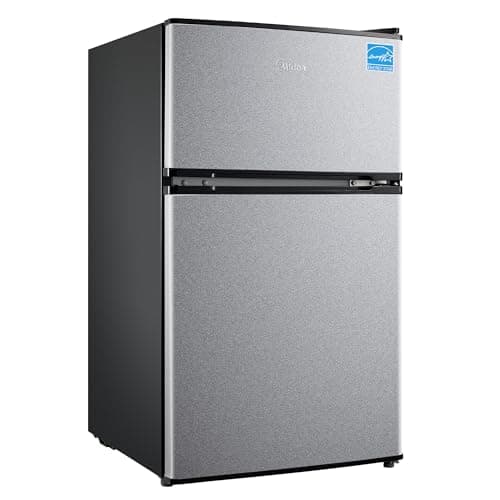 Midea 3.1 cu ft Mini Fridge with Freezer, Energy Star A real freezer and a real brand | A real freezer and a real brand | 8.58.5 out of 10 on our Fits a dorm, Value, Durability, Moves out easily scoring |
#ad — Amazon links on this page are affiliate links. How this site is funded.
Before the review: check your housing contract’s capacity cap. At 3.1 cubic feet this fits a 3.2 or 4.0 cap and does not fit a 3.0 one. A non-compliant fridge gets removed and you have then paid to ship a fridge twice.
With that established, this is our top pick in the dorm fridge roundup for two reasons: a real freezer, and Energy Star certification. As ever, this is an assessment from specification, construction and owner-reported experience rather than a lab test — see how we pick.
The separate freezer door is the product
Most 1.7 cubic foot dorm fridges have a chiller shelf inside the main cabinet, held at roughly 20 to 25°F. That will keep something cold and it will not keep ice cream, because a freezer needs to be near 0°F and a shelf sharing air with the fridge cabinet cannot get there.
This unit has a freezer compartment behind its own door, which is what allows the two temperatures to be genuinely different. In practical terms: frozen meals stay frozen for months, ice cubes are solid, and ice cream is ice cream.
If that matters to you — because you cook, because your meal plan does not cover weekends, or because you want ice — it is the whole reason to buy a 3.0+ unit. If it does not, buy a 1.7 and save both money and floor space. The fridge vs fridge-freezer comparison works through that decision.
Energy Star, and whether it matters to you
A compact fridge is one of the few things in a dorm room running continuously, 24 hours a day for nine months. Efficiency therefore compounds in a way it does not for, say, a desk lamp.
It matters if: your housing bills electricity separately, or you are in apartment-style housing where you pay the utility. Over a year the difference against a non-certified unit of the same size is real money.
It does not matter if: power is included in your housing fee. In that case buy on capacity per dollar, and the Upstreman 3.2 in our roundup is better value.
Some schools also require Energy Star certification for in-room fridges, which turns this from a preference into a specification. Another reason to read the contract first.
Practical notes that affect whether it works well
- Leave 2 to 3 inches clearance at the back and sides. The condenser dumps heat; boxed into a cupboard the compressor runs constantly, uses more power and fails earlier. This is the most common installation mistake.
- Stand it upright for a few hours before switching on if it traveled on its side, so the compressor oil settles back.
- Level it. On an uneven floor with the door corner low, the seal does not close fully — and the door seal is the usual failure point on any compact fridge.
- Plug it into a wall outlet, not a power strip. Compressors draw a startup surge, and many dorms specify this anyway.
- The reversible door is genuinely useful. Dorm layouts are fixed and a door hinged on the wrong side in a narrow room is a daily irritation. Swap it during setup, not after.
The honest limitations
- Most expensive in its class — you are paying for the certification and the brand.
- Mechanical dial, not a digital setpoint. You set a number from 1 to 7 and judge by results. A $10 fridge thermometer removes the guesswork; aim for 37 to 40°F in the fridge.
- The freezer needs manual defrosting periodically. Any compact freezer does. Empty it, unplug, leave the door open with a towel beneath, about an hour.
- It stands on the floor. At 3.1 cubic feet it will not fit under a desk — budget the floor space before ordering.
The short version
- Check the housing capacity cap first. 3.1 cu ft fits a 3.2 cap and fails a 3.0 one.
- A separate freezer door is what allows a real 0°F freezer. A chiller shelf cannot get there.
- Energy Star matters only if you pay for power — or if your school requires it.
- Leave 2–3 inches of clearance behind it. Boxed in, it runs constantly and dies early.
The picks in detail
#ad we may earn a commission · price as of October 6, 2026
#1 · A real freezer and a real brand
Midea 3.1 cu ft Mini Fridge with Freezer, Energy Star
Energy Star certified from a major appliance manufacturer, with a separate freezer compartment that actually holds frozen food rather than slowly thawing it.
- Fits a dorm
- 8.4
- Value
- 7.8
- Durability
- 9.2
- Moves out easily
- 7.6
What we like
- Separate freezer door keeps the freezer genuinely frozen
- Energy Star matters if your dorm or lease bills power
- Midea makes compressors for other brands — the mechanicals are sound
What to know
- Most expensive here
- Check your dorm's cubic-foot limit before ordering — many cap at 3.0 or 4.0
- Mechanical dial, not a digital setpoint
Specifications
- 3.1 cu ft total with a separate freezer compartment
- Energy Star certified
- Reversible door
- Adjustable mechanical thermostat
Who it is for
A student with a 3.1+ cu ft allowance who will keep frozen food. Check the housing contract first.
Common questions
Does the Midea 3.1 mini fridge have a real freezer?
Yes — a freezer compartment with its own door, which is what allows it to hold near 0°F rather than the 20 to 25°F of a chiller shelf. Frozen meals, ice cubes and ice cream all work properly.
Will a 3.1 cu ft fridge be allowed in my dorm?
It fits a 3.2 or 4.0 cubic foot cap and does not fit a 3.0 cap. Caps vary by school and sometimes by building, and some campuses require Energy Star or a rented MicroFridge. Read your housing contract before ordering.
How much space do you need around a mini fridge?
Two to three inches at the back and sides. The condenser releases heat, and a fridge boxed into a cupboard or pushed flat to a wall runs its compressor constantly — more power, more noise, and a shorter life.
How do you defrost a dorm mini fridge freezer?
Empty it, unplug the fridge, and leave the freezer door open with a towel underneath for about an hour. Never chip at the ice with anything metal — puncturing the evaporator ends the fridge. Do it when frost reaches about a quarter inch.
What temperature should a mini fridge be set to?
37 to 40°F in the fridge compartment. Mechanical dials are numbered rather than calibrated, so a $10 fridge thermometer is worth having — the dial number that gives 38°F varies between units and with how full the fridge is.