How many kitchen knives do you need?
Three. A chef's knife, a bread knife and a paring knife handle everything a home kitchen does, and the fifteen-piece set exists because three knives are hard to photograph.
Top pick
Victorinox Swiss Classic 2-Piece Starter Set
A 7-inch santoku and a serrated paring knife from the brand professional kitchens buy on price-to-performance. Two knives, and you will not out-grow either.
#ad we may earn a commission · price as of November 13, 2026
Scored 9.4 · The two knives that do 90% of the work. The full ranking and the runners-up are below.
Quick picks
Our ranking at a glance. Tap any row for the full write-up, or the price to go straight to Amazon. Scores are ours, weighing published specs, the design and what owners report after a year — the method is published in full.
| # | Product | Best for | Score | Price |
|---|---|---|---|---|
| 1 | 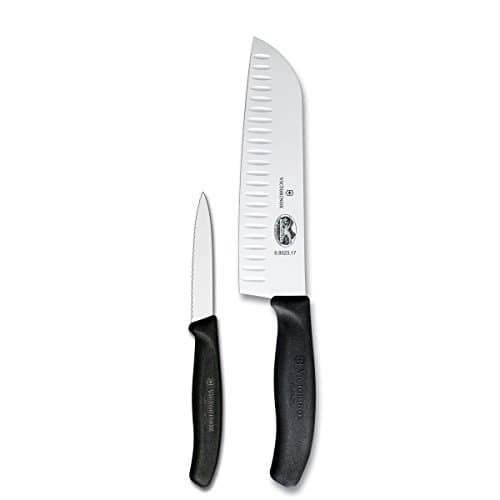 Victorinox Swiss Classic 2-Piece Starter Set The two knives that do 90% of the work | The two knives that do 90% of the work | 9.49.4 out of 10 on our Fits a small kitchen, Value, Durability, Easy to clean scoring | |
| 2 | 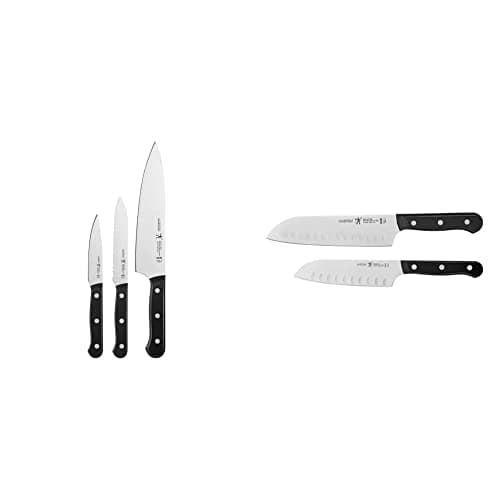 Henckels Solution 5-Piece Knife Set Five blades and no block | Five blades and no block | 9.39.3 out of 10 on our Fits a small kitchen, Value, Durability, Easy to clean scoring | $68.95View on Amazon $69.98 · 1% off |
| 3 | 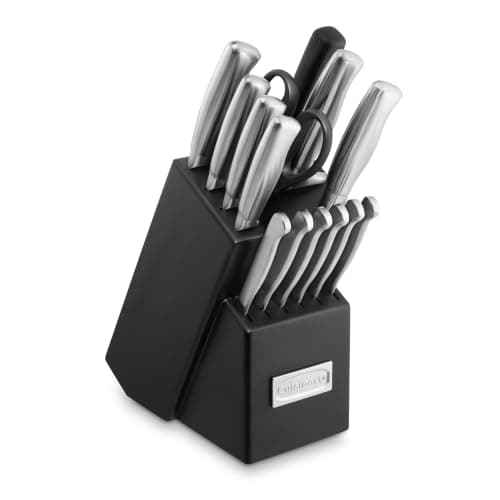 Cuisinart C77SS-15PK 15-Piece Stainless Steel Block Set A full block that holds its edge | A full block that holds its edge | 9.39.3 out of 10 on our Fits a small kitchen, Value, Durability, Easy to clean scoring | $80.04View on Amazon $99.95 · 20% off |
#ad — Amazon links on this page are affiliate links. How this site is funded.
Three knives. A 7 to 8 inch chef’s knife or santoku for almost everything, a serrated bread knife for anything with a crust or a skin that slips, and a 3 to 4 inch paring knife for small work done in your hand. A fourth — a utility knife around 5 inches — is a genuine convenience. Nothing beyond four changes what you can cook.
The three, and what each one is actually for
| Knife | Size | What it does |
|---|---|---|
| Chef's knife or santoku | 7–8 in | Roughly 80% of the work: onions, carrots, herbs, chicken, squash. A santoku is shorter and flatter, which many people find easier in a cramped kitchen. |
| Serrated bread knife | 8–10 in | Crusty bread, but also tomatoes, citrus, cake and anything with a skin a straight edge slides off instead of biting into. |
| Paring knife | 3–4 in | Work done in your hand rather than on the board: peeling, hulling strawberries, deveining, getting a label off a jar. |
| Utility knife (optional) | 5–6 in | The in-between knife. Sandwiches, a single apple, a small block of cheese. Nice to have, never essential. |
Notice what is not on that list. A boning knife, a cleaver, a filleting knife and a carving set are all real tools used by people who do those jobs regularly. If you break down whole chickens weekly you will know it; until then they are objects in a block.
Why sets have fifteen pieces
Three reasons, none of them about cooking. A higher piece count reads as better value on a listing page. Steak knives are cheap to make and six of them add six to the count. And a block makes a set photograph like a complete kitchen, which is exactly the feeling someone furnishing a first apartment is shopping for.
The cost is real: at a fixed budget, every extra piece is steel taken out of the three knives you use daily. A five-knife set and a fifteen-knife set at the same price are not the same purchase.
There is one honest argument for a block set, and it is storage. If you have no spare drawer, the block is doing a job. In that case buy a block set with a built-in sharpener, so the counter space at least buys you a maintained edge.
Where three knives live
Loose knives in a drawer dull against each other, and reaching into that drawer is how people cut themselves in a new kitchen. Three options, cheapest first:
- Blade guards — plastic sheaths, a few dollars each. Unglamorous, effective, and they travel well when you move again.
- An in-drawer knife tray — around $15, holds the blades apart and flat. The best answer if you have a drawer.
- A magnetic strip — roughly $20, but it usually needs screwing into a wall, which is a problem in a rental. Inside a cupboard door is the renter-friendly version; read hanging things without damaging walls before you drill anything.
One sharpener beats two more knives
A sharp cheap knife cuts better than a blunt expensive one, and almost every complaint about a knife set is really a complaint about a dull edge. Budget about $15 for a pull-through sharpener and use it every month or two. A honing rod — the long thin steel that comes in block sets — straightens an edge but does not create one. You want both, and the sharpener is the one that matters.
Two habits do more for an edge than anything you can buy: cut on wood or plastic rather than glass, stone or bare countertop, and wash and dry by hand instead of running knives through the dishwasher.
Which knife to upgrade first, and when
If you started with a budget set, there is a clear order for replacing pieces, and it is not the order the set’s price suggests.
- The chef’s knife or santoku. It does most of the work, so it takes most of the wear and it is the one whose quality you feel every day. A single good 8-inch chef’s knife for $40 to $60 improves cooking more than replacing the other four.
- The paring knife. Cheap to replace and the one most likely to have a handle that slips, which matters because you use it in your hand rather than on a board.
- The bread knife. Serrated edges cannot be sharpened at home, so this is the one knife that genuinely needs replacing rather than maintaining — every few years, depending on how much bread you cut.
Upgrade when the current knife annoys you, not on a schedule. A set that still cuts tomatoes cleanly after a sharpening does not need replacing, whatever it cost.
The short version
- Three knives: chef's or santoku, serrated bread, paring. A utility knife is a useful fourth.
- Piece count in a set is mostly steak knives and a block, not capability.
- Under $100 you can have five good knives — see the under-$100 picks.
- Spend $15 on a sharpener before you spend $40 on a fourth knife.
The picks in detail
#ad we may earn a commission · price as of November 13, 2026
#1 · The two knives that do 90% of the work
Victorinox Swiss Classic 2-Piece Starter Set
A 7-inch santoku and a serrated paring knife from the brand professional kitchens buy on price-to-performance. Two knives, and you will not out-grow either.
- Fits a small kitchen
- 9.7
- Value
- 9.1
- Durability
- 9.6
- Easy to clean
- 9.4
What we like
- Genuinely excellent steel for the money — a professional-kitchen staple
- Handles stay grippy with wet hands
- Two knives cover nearly every task a home cook has
Good to know
No bread knife — add one if you buy real loaves
Specifications
- 7" santoku and 3.25" serrated paring knife
- Stamped high-carbon stainless steel
- Textured Fibrox-style handles, NSF rated
- Dishwasher safe (hand wash still recommended)
Who it is for
Someone who would rather own two good knives than fifteen mediocre ones. Add a serrated bread knife and you are finished.
$69.98 · 1% off
#ad we may earn a commission · price as of November 13, 2026
#2 · Five blades and no block
Henckels Solution 5-Piece Knife Set
Five full-tang blades from a real cutlery brand with no block to eat counter space — the blockless set to buy under $100, provided you can live with two santokus instead of a dedicated bread knife.
- Fits a small kitchen
- 9.6
- Value
- 9.1
- Durability
- 9.3
- Easy to clean
- 9.4
What we like
- Five blades under $70 from a brand with a real cutlery history (Henckels International, est. 1895)
- Full tang on every knife — steel running the length of the handle, not a stub glued into it
- No block means no counter footprint
Good to know
Two of the five are santokus, at 5.5 and 7 inches, so one blade is a duplicate at a different length
Specifications
- 8 in chef, 5 in serrated utility, 4 in paring, plus 5.5 in and 7 in santokus
- Full tang construction with ergonomic handles
- Dishwasher safe; stain and rust resistant blades
- No block — store in a drawer tray or on a magnetic strip
Who it is for
Almost everyone setting up a first kitchen. Choose a block set instead only if you have no drawer to spare.
$99.95 · 20% off
#ad we may earn a commission · price as of November 13, 2026
#3 · A full block that holds its edge
Cuisinart C77SS-15PK 15-Piece Stainless Steel Block Set
Precision taper-ground high-carbon stainless blades in a fifteen-piece block — the set to buy when you want the knife drawer settled for years rather than months. The taper grind is what keeps an edge usable between sharpenings.
- Fits a small kitchen
- 8.8
- Value
- 9.3
- Durability
- 9.5
- Easy to clean
- 9.2
What we like
- Taper-ground high-carbon stainless holds an edge far longer than stamped budget steel
- Fifteen pieces covers every cut a home kitchen makes, shears and block included
- Light in the hand, which matters more than heft over a long prep session
Good to know
The block needs a permanent patch of counter — measure before you order
Specifications
- 15 pieces including block and shears
- Taper-ground high-carbon stainless steel blades
- Featherweight hollow handles
- Full block storage
Who it is for
A first kitchen you intend to cook in properly, with counter space for a block. If counter is the binding constraint, take the Victorinox pair instead.
Our recommendation
If you read nothing else on this page, this is the short version.
Buy this one
Victorinox Swiss Classic 2-Piece Starter Set
Someone who would rather own two good knives than fifteen mediocre ones. Add a serrated bread knife and you are finished.
#ad we may earn a commission · price as of November 13, 2026
Or this one, if Victorinox Swiss Classic is not the fit
Henckels Solution 5-Piece Knife Set
Almost everyone setting up a first kitchen. Choose a block set instead only if you have no drawer to spare.
$69.98 · 1% off
#ad we may earn a commission · price as of November 13, 2026
Common questions
How many knives does a home kitchen really need?
Three. A chef’s knife or santoku, a serrated bread knife and a paring knife cover every normal cooking task. A 5-inch utility knife is a comfortable fourth. Specialist blades — boning, filleting, cleaver — are worth buying only once you know you do that job often.
Is a 15-piece knife set worth it?
Rarely. Most of the count is steak knives, shears and a block, so at a given price you get thinner steel in the three knives you actually use. A block set is defensible if you have counter space and no drawer, and better still if the block includes a sharpener.
Do I need a santoku and a chef's knife?
No — they do the same job. A santoku is shorter, flatter along the edge and often easier to control on a small board, which is why it suits an apartment kitchen. Pick whichever feels better in your hand and skip the other.
How many steak knives do I need?
As many as the most people you seat at once, and only if you eat steak. Four is plenty for most households, and they are cheap to buy separately later — which is better than paying for six inside a set today.
How often should kitchen knives be sharpened?
Every one to two months with ordinary home use, and honed more often than that if your set came with a rod. The test: a knife that will not slice through a tomato skin under its own weight is dull, whatever it cost.