The best hammers for home use
Sixteen ounces, a curved claw and a handle you can hold with one wet hand. Everything above that is for people building things, not hanging them.
Best hammer for home use
Estwing E3-16C 16 oz Curved Claw Hammer
Forged from a single piece of steel, handle included, so there is no joint to work loose — which is how most cheap hammers eventually fail. Estwing has made this in Rockford, Illinois since 1923.
#ad we may earn a commission · price as of November 19, 2026
Scored 9.4 · The one hammer to own. The full ranking and the runners-up are below.
Quick picks
Our ranking at a glance. Tap any row for the full write-up, or the price to go straight to Amazon. Scores are ours, weighing published specs, the design and what owners report after a year — the method is published in full.
| # | Product | Best for | Score | Price |
|---|---|---|---|---|
| 1 | 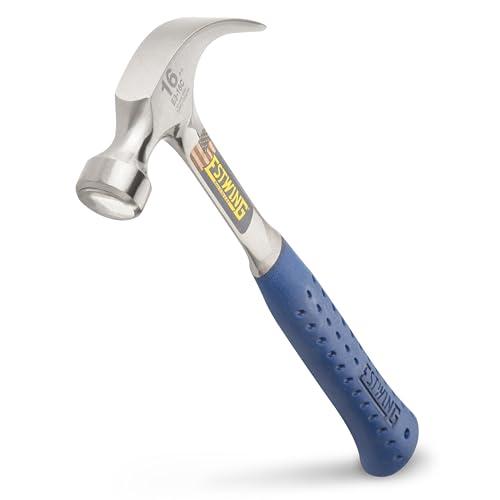 Estwing E3-16C 16 oz Curved Claw Hammer The one hammer to own | The one hammer to own | 9.49.4 out of 10 on our Beginner-friendly, Value, Durability, Stores small scoring | |
| 2 | 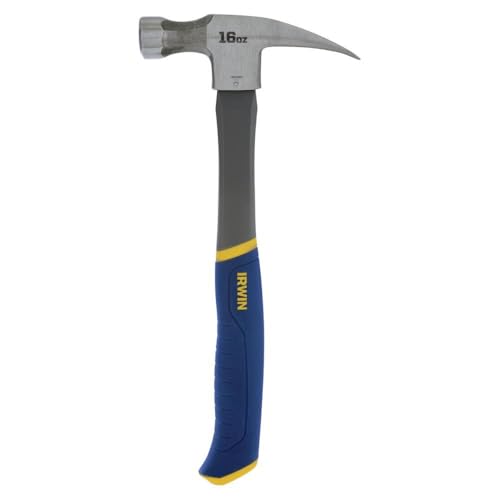 Irwin 1954889 16 oz Fiberglass Claw Hammer The budget pick | The budget pick | 9.29.2 out of 10 on our Beginner-friendly, Value, Durability, Stores small scoring | |
| 3 | 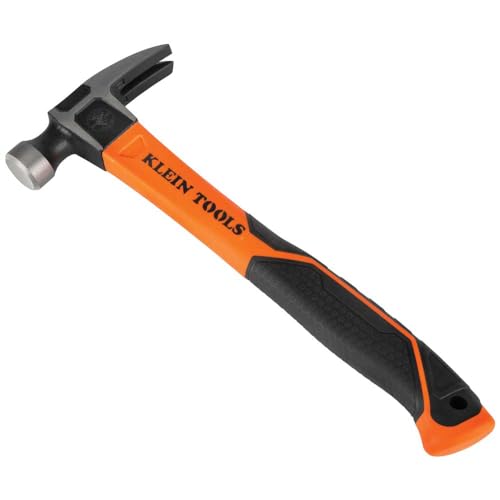 Klein Tools H80816 16 oz Straight-Claw Hammer Prying as much as hammering | Prying as much as hammering | 9.09.0 out of 10 on our Beginner-friendly, Value, Durability, Stores small scoring | |
| 4 | 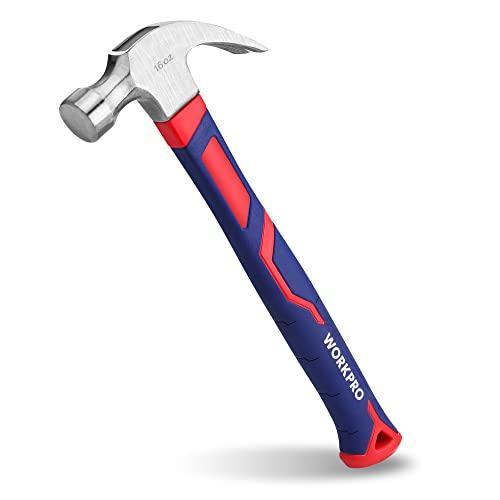 WORKPRO 16 oz Fiberglass Claw Hammer A second hammer for the car or the shared house | A second hammer for the car or the shared house | 9.19.1 out of 10 on our Beginner-friendly, Value, Durability, Stores small scoring | |
| 5 | 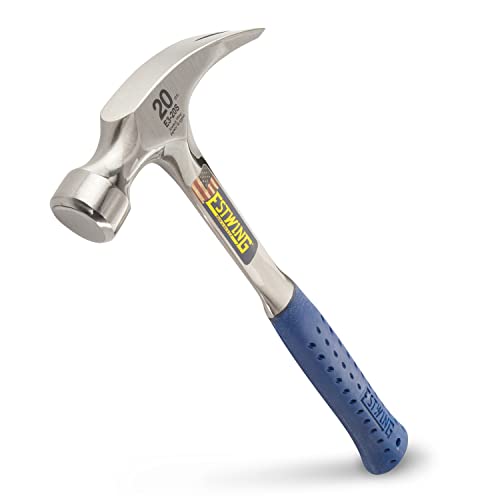 Estwing E3-20S 20 oz Framing Hammer Building something, not hanging something | Building something, not hanging something | 8.88.8 out of 10 on our Beginner-friendly, Value, Durability, Stores small scoring |
#ad — Amazon links on this page are affiliate links. How this site is funded.
For a first house, buy the Estwing E3-16C: 16 oz, curved claw, and forged from a single piece of steel so there is no head-to-handle joint to work loose — which is how almost every cheap hammer eventually fails. For an apartment where the hammer hangs pictures and assembles flat-pack furniture, the Irwin 1954889 does the same job for roughly a third of the money. If your jobs are as much taking apart as putting together, the Klein H80816 straight claw pries where a curved claw cannot reach. Only buy the 20 oz Estwing framing hammer if there is a deck or a fence in your future.
A hammer is the one tool in a first-home kit where the cheap version is genuinely usable and the expensive version is genuinely better, and the gap between them is about twenty dollars. That makes it worth five minutes of thought, which is more than most people give it — the usual approach is to take whichever hammer came in the 142-piece kit and never think about it again.
That is not a terrible outcome. Kit hammers are usually fine. But they are also usually 8 or 10 oz, which is a tack hammer wearing a hammer’s clothes, and the first time you try to pull a nail out of a stud with one you will understand why this page exists.
Scores below weigh published specifications, the physical design and consistent owner-reported experience over time. See how we pick.
Why 16 oz, and what the number actually means
The ounce figure on a hammer is the weight of the head, not the whole tool. It is the specification that decides how hard the hammer hits for a given swing, and it trades directly against control.
| Head weight | What it suits | The trade |
|---|---|---|
| 8 to 10 oz | Tacks, panel pins, small picture hooks | Too light to drive a nail into a stud without a dozen swings |
| 16 oz | Everything a home does: picture hooks, furniture, fence pickets, pulling nails | The default for a reason. Nothing to trade |
| 20 oz | Framing, decking, fencing, demolition | Drives faster, tires you faster, and is less accurate on small work |
| 22 oz and up | Professional framing, all day | Wrong tool for a household entirely |
Four of the five picks here are 16 oz, and that is not a lack of imagination. For a home, 16 oz is genuinely the answer: heavy enough to sink a 3 in nail into a stud in a handful of swings, light enough to tap a furniture dowel home without splitting it. The 20 oz Estwing is on the list for the one reader who is building something outdoors.
One-piece steel, fiberglass or wood
Hammers fail at the joint between head and handle. Everything about handle construction follows from that single fact.
- One-piece forged steel. The head and handle are the same piece of metal, so there is no joint at all. This is what Estwing has done in Rockford, Illinois since 1923, and it is why a 40-year-old Estwing is still a working hammer. The cost is shock: steel transmits more vibration into your hand than fiberglass, which is why Estwing molds a grip over it and claims a 70% reduction.
- Fiberglass. A forged head fixed to a fiberglass shaft, usually with an overmolded rubber grip. Absorbs more shock than solid steel, costs much less, and is non-conductive — which is a genuine safety point if you are ever working near wiring. The joint is still a joint, and a badly missed swing that hits the shaft instead of the nail will eventually tell.
- Wood (hickory). The traditional answer, still the nicest to swing, and the only one you can re-handle rather than replace. It is also the one that dries out, loosens in a hot loft and needs occasional attention. None of the picks here is wooden, because for a household tool that gets used four times a year, a handle that needs maintenance is a handle that will not get it.
Curved claw or straight claw
The second real decision, and the one people get wrong because the straight claw looks more serious.
| Claw | Best at | Worse at |
|---|---|---|
| Curved claw | Pulling nails — the curve gives leverage as you rock the hammer back | Getting into a tight seam between two boards |
| Straight (rip) claw | Prying boards apart, levering trim, demolition, splitting | Pulling nails; less leverage, more wrist |
For a home, the curved claw is right the great majority of the time, because the job you do most is taking out a nail you put in crooked. A straight claw earns its place if you are opening crates, taking apart pallets or lifting baseboard — real work, but not apartment work. The Klein H80816 is here for that reader, and the Estwing E3-20S is a rip claw for the same reason.
How we picked: four things, in this order
- A forged head, not a cast one. Every pick here states a forged steel head. Forging aligns the grain of the metal; casting does not, and a cast head can chip at the face or the claw. On a $12 hammer this is the specification that separates a real tool from a novelty.
- How the head is attached — or whether it is attached at all. We weighted the one-piece forgings highest, because the joint is the failure point in every other design. Where there is a joint we say so in that pick’s cons.
- A grip that works with one wet hand. Molded or two-shot overmolded grips over slipped-on rubber sleeves. This is not a comfort point: a hammer that turns in your hand on the downswing is how people hit a thumb.
- 16 oz unless there is a reason not to be. We did not pad the list with weights a household will not use. Four of five picks are 16 oz and the fifth is explicitly labeled as the wrong hammer for an apartment.
One thing we did not weight: magnetic nail starters and side nail pullers. They are genuinely useful on a roof and genuinely irrelevant hanging a shelf, and they push the price up by half.
Smooth face or milled face
A third specification, which is simpler than the other two: buy smooth.
A milled face — the waffle pattern you see on framing hammers — bites the nail head so the hammer does not skate off, which is why framers use one all day. It also stamps that waffle pattern into anything it touches. On trim, on a cabinet, on a door frame, on drywall, that mark is permanent and visible, and in a rental it is the kind of thing that comes out of a deposit. Every pick on this page is a smooth face for exactly that reason.
If you are hanging anything that must not be marked, the real answer is not a different face — it is to stop using the hammer at all and use an adhesive strip instead. That trade-off is worked through in how to hang things without damaging walls.
What to skip
Four hammers that look like the answer and are not:
- The 8 oz hammer in a household tool kit. Fine for a picture hook, and genuinely frustrating for anything held together with a 3 in nail. If your kit came with one, keep it for tacks and buy a 16 oz as well.
- A multi-pack of three identical hammers. They appear high in search results because they are cheap per unit. You need one hammer. A second one in the car is defensible; a third is a drawer problem.
- A ball-peen hammer, unless you are working metal. It has no claw, so it cannot pull a nail, which is half of what a household hammer does.
- A rubber mallet as your only hammer. Right for furniture dowels and tent pegs, useless for nails. It is a second purchase, not a substitute — and usually one that can wait.
Four rules that cover almost every hammer injury
- Start the nail with your fingers, then move your hand. Hold the nail near the head to set it, give it one light tap, then take your hand away before you swing properly. Most thumb injuries happen on the second full-force swing, not the first tap.
- Hit it with the face, square on. Striking with the cheek — the side of the head — is what chips a hammer and sends a fragment flying. Hammer faces are hardened; the cheeks are not meant to take an impact.
- Wear eye protection when you pull nails. A nail under tension can let go suddenly, and an old nail can shear. A pair of safety glasses is a few dollars and lives in the same box as the hammer.
- Put a block under the claw when you lever. A scrap of wood under the hammer head gives you more leverage and stops the claw crushing the wall or the floorboard you are pulling against. This is the single most useful habit on this list.
The short version
- 16 oz is the right head weight for a home. 8 oz is a tack hammer; 20 oz is for building, not hanging.
- A one-piece forged hammer has no head-to-handle joint, which is where every other design eventually fails.
- Curved claw for pulling nails, straight claw for prying things apart. Most homes want curved.
- Buy a smooth face. A milled face stamps a permanent waffle pattern into anything it touches.
- Set the nail with a light tap, then move your hand before swinging properly.
Every pick in detail
#ad we may earn a commission · price as of November 19, 2026
#1 · The one hammer to own
Estwing E3-16C 16 oz Curved Claw Hammer
Forged from a single piece of steel, handle included, so there is no joint to work loose — which is how most cheap hammers eventually fail. Estwing has made this in Rockford, Illinois since 1923.
- Beginner-friendly
- 9.4
- Value
- 8.6
- Durability
- 9.9
- Stores small
- 9.1
What we like
- A one-piece forging has no head-to-handle joint, which is where wooden and fiberglass hammers die
- The curved claw gives more leverage pulling nails than a straight claw
- Made in the USA and sold under the same part number for decades, so you know what you are getting
Good to know
Steel transmits more shock than fiberglass even with the grip — a long day of nails is felt
Specifications
- 16 oz head, smooth face
- Curved claw
- Forged in one piece — head and handle are the same steel
- 13 in overall length
- Patented shock reduction grip; Estwing claims 70% vibration reduction
Who it is for
Anyone buying one hammer for a first house and not planning to buy another. The default answer.
#ad we may earn a commission · price as of November 19, 2026
#2 · The budget pick
Irwin 1954889 16 oz Fiberglass Claw Hammer
A forged steel head on a fiberglass handle from a brand that has been in hardware stores for a century. It is the cheapest thing here and it does the job a renter needs a hammer to do.
- Beginner-friendly
- 9.6
- Value
- 9.9
- Durability
- 8.4
- Stores small
- 9.4
What we like
- The budget pick by a distance, and still a forged head rather than a cast one
- Fiberglass absorbs more shock than solid steel
- Light enough to leave in a kitchen drawer rather than a toolbox
Good to know
The head is attached to the handle rather than forged with it — the eventual failure point
Specifications
- 16 oz forged steel head, smooth face
- Fiberglass handle with ProTouch grip
- 12.75 in overall length
- Listed weight 1.54 lb
- Hardened end cap on the handle
Who it is for
A renter hanging pictures and assembling furniture, who wants a real hammer without spending real money.
#ad we may earn a commission · price as of November 19, 2026
#3 · Prying as much as hammering
Klein Tools H80816 16 oz Straight-Claw Hammer
A straight claw on a fiberglass core with a two-shot overmolded grip, plus a tether hole in the handle. Straight claws are worse at pulling nails and much better at getting between two boards.
- Beginner-friendly
- 8.9
- Value
- 8.8
- Durability
- 9.2
- Stores small
- 9.3
What we like
- A straight claw wedges into a seam a curved claw cannot reach — better for taking things apart
- The two-shot overmold is a genuinely better grip than a slipped-on rubber sleeve
- The hang hole means it lives on a hook rather than at the bottom of a box
Good to know
A straight claw has less leverage pulling nails than a curved one — the trade works both ways
Specifications
- 16 oz head, smooth face
- Straight claw
- High-strength fiberglass core with a molded-over handle
- 13 in overall length
- Hang hole in the handle end for tethering or storage
Who it is for
Someone whose jobs are as much demolition as construction — pulling apart pallets, lifting trim, opening crates.
#ad we may earn a commission · price as of November 19, 2026
#4 · A second hammer for the car or the shared house
WORKPRO 16 oz Fiberglass Claw Hammer
A forged head, a curved claw and a non-slip fiberglass handle at a price that makes owning two hammers reasonable. The sensible middle of this list.
- Beginner-friendly
- 9.3
- Value
- 9.4
- Durability
- 8.6
- Stores small
- 9.3
What we like
- Forged and hardened head at a price closer to the budget pick than the premium one
- The angled claw works in the tight gaps a long straight claw cannot enter
- Fiberglass handle is non-conductive, which matters if you are ever near a live wire
Good to know
WORKPRO is a house brand with no long service history behind this part number
Specifications
- 16 oz forged, hardened steel head, polished smooth face
- Curved claw, angled for tight spaces
- Fiberglass handle with non-slip grip
- Listed weight 1 lb
- Clear-coated finish against corrosion
Who it is for
A shared house or a first apartment that wants a decent hammer without the Estwing premium, or a second one to keep in the car.
#ad we may earn a commission · price as of November 19, 2026
#5 · Building something, not hanging something
Estwing E3-20S 20 oz Framing Hammer
The same one-piece forging as the 16 oz curved claw, with four more ounces of head and a rip claw. Four ounces does not sound like much until you are driving a box of framing nails.
- Beginner-friendly
- 7.6
- Value
- 8.5
- Durability
- 9.9
- Stores small
- 9.0
What we like
- The extra head weight drives a nail in fewer swings once you are past picture hooks
- Rip claw pries, splits and demolishes in a way a curved claw does not
- Same one-piece forging and lifetime-grade construction as the 16 oz
Good to know
Too much hammer for hanging a shelf — the extra weight is tiring and less accurate for small work
Specifications
- 20 oz head, smooth face
- Straight rip claw
- Forged in one piece from solid steel
- Patented shock reduction grip
- Listed weight 1.3 lb
Who it is for
A first house with a deck, a fence or a workshop in its future. Not the hammer for an apartment.
Our recommendation
If you read nothing else on this page, this is the short version.
Buy this one
Estwing E3-16C 16 oz Curved Claw Hammer
Anyone buying one hammer for a first house and not planning to buy another. The default answer.
#ad we may earn a commission · price as of November 19, 2026
Or this one, if Estwing E3-16C Curved is not the fit
Irwin 1954889 16 oz Fiberglass Claw Hammer
A renter hanging pictures and assembling furniture, who wants a real hammer without spending real money.
#ad we may earn a commission · price as of November 19, 2026
Common questions
What size hammer should I buy for home use?
A 16 oz claw hammer. That is the head weight, and it is heavy enough to drive a 3 in nail into a stud in a few swings while staying controllable for small work like furniture dowels and picture hooks. An 8 or 10 oz hammer — the size that usually comes in a household kit — is a tack hammer and will frustrate you the first time you need real force. A 20 oz is for framing and decking.
Is a fiberglass or steel hammer better?
It depends what you are optimizing for. A one-piece forged steel hammer like the Estwing has no head-to-handle joint, so it is effectively unbreakable, but it transmits more shock into your hand. Fiberglass absorbs more vibration and costs much less, at the price of a joint that can eventually loosen. For a household tool used a few times a month, both are fine; for a tool you want to hand down, the one-piece forging is the one.
What is the difference between a claw hammer and a framing hammer?
Head weight and claw shape, mostly. A claw hammer for home use is typically 16 oz with a curved claw for pulling nails. A framing hammer is heavier — 20 to 22 oz — with a straight rip claw for prying and often a milled face that bites the nail. The framing hammer drives nails faster and marks everything it touches, which is why it belongs on a building site rather than in an apartment.
Do I need a hammer if I already have a drill?
Yes, and they do different jobs. A drill drives screws and makes holes; a hammer drives nails, taps furniture dowels home, seats a stubborn joint and — the part people forget — pulls nails back out. A first-home kit wants both, and the drill side of that decision is covered in the best drills for new homeowners.
Can I use a hammer to hang pictures in a rental?
For a small picture hook, usually yes — a pin-type hook leaves a hole about the size of a pencil tip that fills with a dab of spackle. For anything heavier, or on plaster, the question is less about the hammer and more about whether you can find a stud and whether your lease allows holes at all. Adhesive strips avoid the issue entirely for lighter frames.
Why does my hammer keep bending nails?
Three usual causes, in order. The hammer is too light, so you are swinging harder and less squarely. You are hitting at an angle rather than straight down the nail’s axis. Or the nail is too thin for the wood — a finish nail going into a hardwood stud will bend no matter how well you swing. Heavier hammer, square strike, right nail, in that order.
Sources
Read next
- Best tool kits for new homeownersWhere the hammer that came free is probably too light.
- A first-apartment tool kitSeven tools, about $45, fits a kitchen drawer.
- How to hang things without damaging wallsWhen not to reach for the hammer at all.
- Best stud finders for home useWhat you should use before the first nail goes in.
- Best tool boxes for homeWhere it lives, with the safety glasses.
- The first-home essentials checklistEverything a first house needs, with a running total.
Brands: want your product tested? For Brands.