Nonstick vs stainless steel cookware
Nonstick is a consumable you replace every two or three years. Stainless is a one-time purchase that needs technique. Both answers are defensible — here is which fits your situation.
Quick picks
Our ranking at a glance. Tap any row for the full write-up, or the price to go straight to Amazon. Scores are ours, from published specs and what owners report after a year — we have not lab-tested these, and we say so plainly.
| # | Product | Best for | Score | Price |
|---|---|---|---|---|
| 1 | 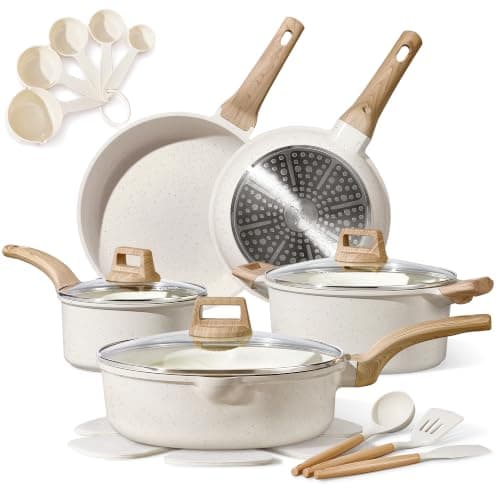 CAROTE 20-Piece Detachable-Handle Nonstick Set Kitchens with two or three cabinets | Kitchens with two or three cabinets | 8.68.6 out of 10 on our Fits a small kitchen, Value, Durability, Easy to clean scoring | $69.99View on Amazon $109.99 · 36% off |
| 2 | 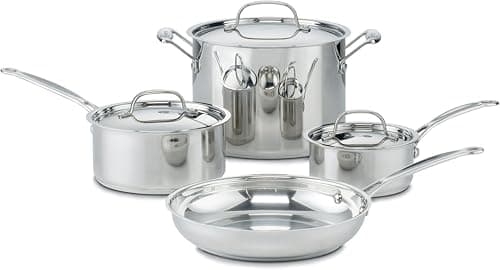 Cuisinart Chef's Classic Stainless 7-Piece Set Buying once and not again | Buying once and not again | 8.38.3 out of 10 on our Fits a small kitchen, Value, Durability, Easy to clean scoring | $84.95View on Amazon $119.95 · 29% off |
| 3 | 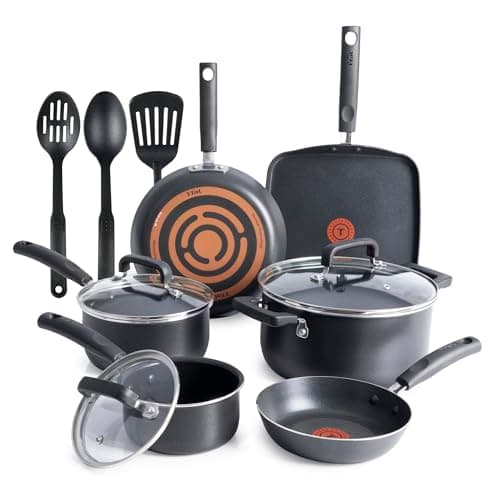 T-fal Signature Nonstick 12-Piece Set A safe, known-brand default | A safe, known-brand default | 8.18.1 out of 10 on our Fits a small kitchen, Value, Durability, Easy to clean scoring | |
| 4 | 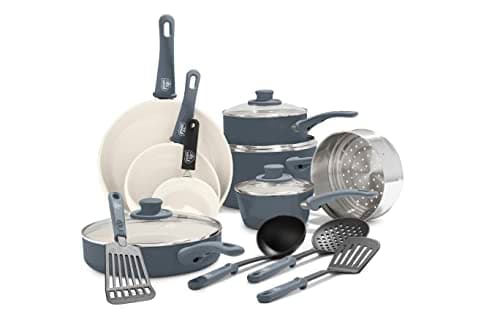 GreenLife 16-Piece Ceramic Nonstick Set The lowest sensible spend | The lowest sensible spend | 7.87.8 out of 10 on our Fits a small kitchen, Value, Durability, Easy to clean scoring | $69.99View on Amazon $99.99 · 30% off |
#ad — Amazon links on this page are affiliate links. How this site is funded.
Buy nonstick for a one- or two-year lease, and stainless if you are staying put or already cook. Nonstick needs no technique and will need replacing in two to three years. Stainless never wears out but food sticks until you learn to preheat it properly.
This is not really a quality question — both materials are good at different things, and professional kitchens use both. It is a question about how long you are staying and how much you want to learn.
Side by side
| Nonstick (PTFE or ceramic) | Stainless steel | |
|---|---|---|
| Eggs on week one | Slide straight out | Stick unless you preheat properly |
| Service life | 2–3 years of real use | Decades |
| Max oven temperature | Typically 350–480°F | Broiler safe |
| Searing and browning | Poor — does not get hot enough safely | Excellent — this is what it is for |
| Metal utensils | Never | Fine |
| Dishwasher | Shortens coating life | Fine |
| Weight | Light | Heavy |
| Cost over 10 years | 3–4 sets, roughly $240–$300 | One set, roughly $85–$125 |
| Learning curve | None | A week or two |
The coating safety question, answered carefully
This gets discussed badly online, so here is what the actual position is. Modern nonstick cookware sold in the US uses PTFE, and PFOA — the chemical that generated most of the concern — has not been used in its manufacture in the United States since 2013 following an EPA stewardship program. Current PTFE pans are not made with PFOA.
The genuine, documented risk with PTFE is overheating. Above roughly 500°F the coating begins to break down and release fumes, which is a real hazard to pet birds in particular. In practice that means: do not preheat an empty nonstick pan on high, do not use it under a broiler, and do not use it for high-heat searing. Those are also the things that destroy the coating, so the safety advice and the longevity advice point the same way.
Ceramic coatings (like the GreenLife set) contain no PTFE at all, which some people prefer. The honest trade is that ceramic coatings lose their release properties faster — often inside 18 months — so you replace them more often.
Stainless steel has no coating and therefore none of this conversation. If the question bothers you, that is a reasonable basis for buying stainless.
How to cook on stainless without food sticking
Nearly everyone who gives up on stainless does so because of this, and it is a two-minute fix:
- Heat the empty pan on medium for two to three minutes. Not high — high warps pans and burns oil.
- Test with water. Flick in a few drops. If they sizzle and evaporate, it is not hot enough. When a drop forms a bead and skates across the surface, it is ready. This is the Leidenfrost effect, and it is a genuinely reliable indicator.
- Then add the oil, let it shimmer for a few seconds, then add the food.
- Leave it alone. Protein releases on its own when a crust forms. Moving it early is what tears it.
Done that way, stainless releases eggs nearly as well as nonstick. Done without the preheat, everything welds to the pan — which is the experience most people have had and concluded that stainless is difficult.
What we would actually buy
For most readers of this site — someone setting up a first apartment this month, on a one-year lease — a nesting nonstick set is the right call, and we say so in our cookware roundup. Cabinet space is the binding constraint, the budget has to cover an entire apartment, and in two years you may be in a different kitchen entirely.
The combination we would really recommend, if the budget stretches: a small stainless set plus one cheap nonstick frying pan for eggs, around $20. You get searing and broiling from the stainless, easy eggs from the nonstick, and you only ever replace the cheap pan.
The short version
- Short lease, small cabinets, no cooking experience: nonstick. Staying put, already cook: stainless.
- US-made PTFE has not used PFOA since 2013. The real risk is overheating above ~500°F.
- Stainless releases food fine if you preheat on medium and use the water-bead test.
- The best-value setup is a small stainless set plus one cheap nonstick pan for eggs.
The picks in detail
#1 · Kitchens with two or three cabinets
CAROTE 20-Piece Detachable-Handle Nonstick Set
The handles come off and the pans nest, so a 20-piece set stores in roughly the space of one stockpot — the single most useful thing a cookware set can do in a small apartment.
- Fits a small kitchen
- 9.4
- Value
- 8.6
- Durability
- 6.8
- Easy to clean
- 8.8
What we like
- Nests into a single cabinet — the reason to buy it
- Works on electric coil, gas and induction
- Detached handles mean it goes straight from stove to oven to table
What to know
- Nonstick coating is a consumable: expect two to three years of real use
- The detachable handle takes a day to trust — it clicks, it does not screw
- 20 pieces is more than anyone needs; four will stay in the box
Specifications
- Handles detach; pans and lids nest into one stack
- Granite-style nonstick coating, PFOA-free
- Induction-compatible base
- Oven safe to 480°F with handles removed
Who it is for
A first apartment where cabinet space, not cooking ambition, is the binding constraint. Skip it if you already know you want cookware that lasts a decade — buy the Cuisinart stainless instead.
#2 · Buying once and not again
Cuisinart Chef's Classic Stainless 7-Piece Set
Stainless with an aluminum-encapsulated base: no coating to wear out, so this is the set you still own in your third apartment.
- Fits a small kitchen
- 7.6
- Value
- 7.6
- Durability
- 9.6
- Easy to clean
- 7.0
What we like
- Nothing to wear out — no coating, no replacement cycle
- Broiler safe, so it handles far more recipes than the nonstick sets
- Works on every stovetop including induction
What to know
- Food sticks until you learn to preheat properly — a real learning curve
- Heaviest set here
- Costs more up front than two cheap nonstick sets
Specifications
- 7 pieces — the useful ones, no filler
- Aluminum-encapsulated base for even heating
- Induction-compatible
- Oven and broiler safe; dishwasher safe
Who it is for
Someone who cooks already, or who would rather spend once. Skip it if you want eggs to slide out on week one with no technique.
#ad we may earn a commission · price as of October 6, 2026
#3 · A safe, known-brand default
T-fal Signature Nonstick 12-Piece Set
The boring correct answer: a long-running set from a brand that has made nonstick for decades, with the thermal-indicator spot that stops beginners cooking on a cold pan.
- Fits a small kitchen
- 7.0
- Value
- 8.4
- Durability
- 7.4
- Easy to clean
- 9.0
What we like
- The heat indicator genuinely helps if you have not cooked much
- Replacement parts and matching pieces are easy to find years later
- Light enough to handle one-handed when full
What to know
- Not induction-compatible — check your stovetop first
- 350°F oven limit is low; it rules out a lot of roasting recipes
- Does not nest, so it needs real cabinet depth
Specifications
- 12 pieces including two fry pans, two saucepans, a Dutch oven and a steamer insert
- Thermo-Spot heat indicator turns solid red at temperature
- Oven safe to 350°F
- Dishwasher safe; not induction-compatible
Who it is for
Anyone with a gas or electric-coil stove who wants to stop thinking about it. Not for an induction cooktop.
#4 · The lowest sensible spend
GreenLife 16-Piece Ceramic Nonstick Set
A ceramic-coated set at close to the cheapest price that is still worth owning, with utensils and a few extras thrown in so you need fewer separate purchases on day one.
- Fits a small kitchen
- 7.8
- Value
- 9.2
- Durability
- 5.6
- Easy to clean
- 8.4
What we like
- Cheapest route to a complete starter kitchen
- Ceramic coating releases well while it is new
- Includes utensils you would otherwise buy separately
What to know
- Ceramic coatings lose their release faster than PTFE — often inside 18 months
- Thin bases mean hot spots on an electric coil
- Not induction-compatible
Specifications
- 16 pieces including lids and kitchen utensils
- Ceramic nonstick coating, PFAS-free
- Oven safe to 350°F
- Not induction-compatible
Who it is for
A one-year lease, a sublet, or a budget that has to cover an entire apartment this month. Treat it as a two-year purchase, not a lifetime one.
Common questions
Is nonstick cookware safe?
Modern PTFE nonstick sold in the US is not manufactured with PFOA — that was phased out under an EPA stewardship program completed in 2013. The documented risk is overheating: above roughly 500°F the coating degrades and releases fumes, which is particularly hazardous to pet birds. Keep nonstick to medium heat, never preheat it empty on high, and never use it under a broiler.
How long does nonstick cookware last?
Two to three years of regular use for PTFE, often less for ceramic. That is the material behaving normally, not a defect. Hand washing, medium heat only and no metal utensils extends it; a dishwasher and high heat shortens it considerably.
Why does food stick to my stainless steel pan?
The pan was not hot enough before the oil went in. Heat it empty on medium for two or three minutes, then flick in a drop of water: if it beads up and skates, it is ready. Then add oil, then food, then leave it alone until a crust forms.
Can you put stainless steel pans in the dishwasher?
Yes. They may develop a dull film or rainbow discolouration over time from detergent, which is cosmetic and comes off with a little vinegar or a stainless cleaner. Nonstick is also often labeled dishwasher safe but the coating lasts noticeably longer if you hand wash.
Is ceramic nonstick better than PTFE?
It contains no PTFE, which some people prefer on principle. The trade is durability — ceramic coatings commonly lose their release in 12 to 18 months versus two to three years for PTFE. Neither is dangerous in normal use; it is a preference, with a cost attached.