What tools do you need to mount a TV on the wall?
Four tools and about an hour. The tool that decides whether the job goes well is the cheap one people skip, which is the stud finder.
Top pick
Franklin Sensors ProSensor M150 9-Sensor Stud Finder
Nine sensors and fifteen LEDs read the wall in one placement and light up over the whole stud, so you see its full width immediately. No calibration, no sweeping, no second guess.
#ad we may earn a commission · price as of November 13, 2026
Scored 9.5 · Finding the stud first time. The full ranking and the runners-up are below.
Quick picks
Our ranking at a glance. Tap any row for the full write-up, or the price to go straight to Amazon. Scores are ours, weighing published specs, the design and what owners report after a year — the method is published in full.
| # | Product | Best for | Score | Price |
|---|---|---|---|---|
| 1 | 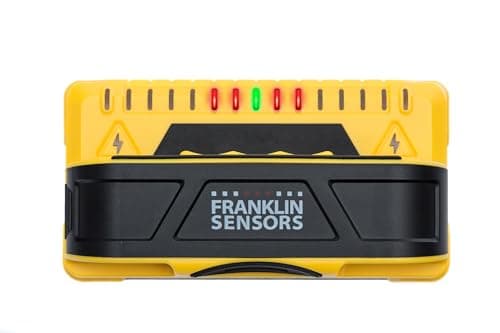 Franklin Sensors ProSensor M150 9-Sensor Stud Finder Finding the stud first time | Finding the stud first time | 9.59.5 out of 10 on our Beginner-friendly, Value, Durability, Stores small scoring | |
| 2 | 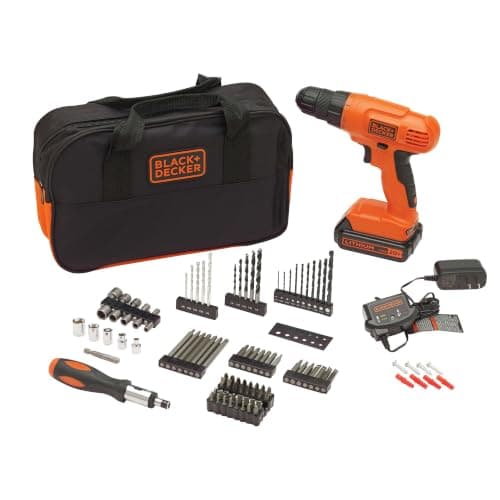 BLACK+DECKER 20V MAX Drill Driver Kit with 100 Accessories A first drill, with bits included | A first drill, with bits included | 9.59.5 out of 10 on our Beginner-friendly, Value, Durability, Stores small scoring | |
| 3 | 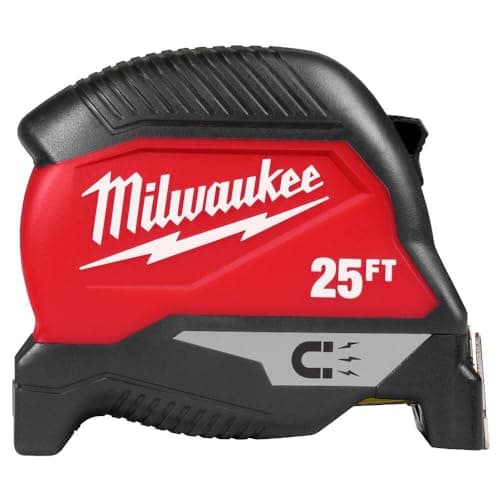 Milwaukee 25 ft Magnetic Tape Measure Measuring alone | Measuring alone | 9.59.5 out of 10 on our Beginner-friendly, Value, Durability, Stores small scoring | $21.95View on Amazon $24.47 · 10% off |
| 4 | 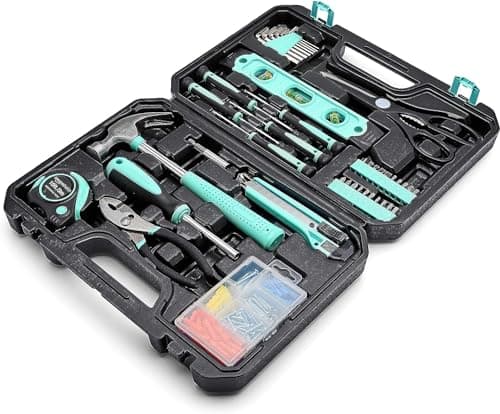 Amazon Basics 142-Piece Household Tool Kit The whole first-home kit, one box | The whole first-home kit, one box | 9.59.5 out of 10 on our Beginner-friendly, Value, Durability, Stores small scoring |
#ad — Amazon links on this page are affiliate links. How this site is funded.
Four tools: a stud finder, a cordless drill, a level and a tape measure. The mount itself supplies the lag bolts and usually the TV-side screws. You also want a pencil, a socket or wrench to drive the lag bolts, and a second person for the lift. A TV must be bolted into wood studs or solid masonry — never into drywall alone, whatever the anchors claim.
The four tools, and why each one is on the list
| Tool | What it does | Can you skip it? |
|---|---|---|
| Stud finder | Locates the wood framing behind the drywall, and the edges of it. | No. This is the tool the job stands or falls on. |
| Cordless drill | Drills the pilot holes and drives the lag bolts. | No. A hand screwdriver will not drive a lag bolt into a stud. |
| Level | Keeps the bracket straight. A 2-degree tilt is obvious from the sofa. | No, but the one in a 142-piece household kit is fine. |
| Tape measure | Sets the height and centres the bracket on the wall. | No. Eye-level centring is reliably wrong. |
| Socket or adjustable wrench | Final tightening of the lag bolts. | Sometimes — many mounts include a hex key that does the job. |
Two notes on the drill. You need a drill, not an impact driver — an impact driver will happily over-torque a lag bolt and strip the hole in soft framing. And you need the right pilot bit: usually 1/8 to 3/16 inch for a standard lag bolt, and the mount’s instructions will name the size. Drilling the pilot hole too large is the quiet way to halve the holding strength. If you are deciding between tool types, our drill vs impact driver comparison covers it.
If you rent, settle this before you buy anything
A TV mount means four lag-bolt holes in the wall, roughly 3/16 of an inch across, in studs. That is not a nail hole, and it is not something a tub of filler disguises to a move-out inspector’s satisfaction.
Ask your landlord in writing. Many will say yes, some will say yes on condition you patch and repaint at move-out, and some will say no. If the answer is no or you would rather not risk the deposit, the alternatives that genuinely work are a floor-standing TV stand, a TV easel, or simply the stand the TV came with on a low unit. Adhesive strips do not hold a television — there is no renter-friendly no-hole method for this one, and anything marketed as such is worth treating with suspicion. Our guide to renter-safe repairs you can do yourself covers what you can patch convincingly and what you cannot.
The order of operations
- Find the studs and mark both edges. Studs are typically 16 inches apart on centre, sometimes 24. A multi-sensor stud finder shows the whole width of the stud at once, which means you can mark the centre rather than guessing at it. Confirm with a second pass from the other direction.
- Decide the height. The usual target is the centre of the screen at eye level when seated — for most sofas that puts the centre around 42 inches from the floor. Measure your own seated eye height; it is a better number than any rule of thumb.
- Mark the bracket holes. Hold the wall plate up, level it, and mark through the holes that land on stud centres. Not the holes that are convenient — the ones on studs.
- Drill pilot holes at the size the instructions specify, to the depth of the lag bolt. A strip of tape on the drill bit is a perfectly good depth stop. Mount hardware usually calls for a bit in the 3/16 to 3/8 inch range, which the cheapest mixed bit sets do not reach — see the best drill bit sets for home use.
- Drive the lag bolts and check the plate is still level before the last half-turn on each.
- Attach the TV-side brackets using the screws supplied with the mount, matching your TV’s VESA pattern. Do not substitute longer screws; they can reach the panel electronics.
- Lift and hook on, with two people. Then route the cables and tidy them before you sit down.
What you must not mount into
- Drywall alone. No anchor sold for hollow drywall is appropriate for a television, regardless of its stated rating. The failure is not gradual.
- Plaster and lath without finding the lath joists. Common in older buildings and it needs the framing located properly; the plaster itself carries nothing.
- A wall with pipes or cables in it. Scan before you drill. Many stud finders have an AC-wire detection mode; use it, and be especially careful directly above or below an outlet or switch, where cables run vertically.
- Exterior masonry without masonry anchors and a hammer drill. A standard drill will not pilot a hole in brick or concrete, and a wood lag bolt holds nothing in it.
One last thing worth saying plainly: a TV that is not wall-mounted should be anchored to the furniture it sits on. Tip-overs are a genuine hazard in a home with children, and an anti-tip strap costs a few dollars.
The short version
- Stud finder, drill, level, tape measure. The mount brings the bolts.
- Bolt into studs or solid masonry. Never into drywall alone.
- Use a drill, not an impact driver, and pilot at the size the instructions give.
- Renting? Get written permission first — there is no no-hole method. See our stud finder picks.
- For a TV, the stud’s center matters as much as finding it at all — the Franklin ProSensor M150 review explains why.
The picks in detail
#ad we may earn a commission · price as of November 13, 2026
#1 · Finding the stud first time
Franklin Sensors ProSensor M150 9-Sensor Stud Finder
Nine sensors and fifteen LEDs read the wall in one placement and light up over the whole stud, so you see its full width immediately. No calibration, no sweeping, no second guess.
- Beginner-friendly
- 9.7
- Value
- 9.1
- Durability
- 9.6
- Stores small
- 9.2
What we like
- Dramatically more reliable than single-sensor finders, which is the whole point
- Shows stud width, so you can center a screw properly
- Live-wire warning before you drill into a cable
Good to know
Twice the price of a basic finder
Specifications
- 9 sensors and 15 LEDs read the wall in a single placement — no sweeping
- Shows both stud edges at once — no edge-finding routine
- AC live-wire warning
- No calibration step; place it flat and press
Who it is for
Anyone hanging a TV, heavy shelf or mirror. Getting this wrong costs more than the tool.
#ad we may earn a commission · price as of November 13, 2026
#2 · A first drill, with bits included
BLACK+DECKER 20V MAX Drill Driver Kit with 100 Accessories
The drill and the hundred bits and sockets you would otherwise buy separately, at a price that makes the decision easy. For hanging shelves and building furniture it is all the drill you need.
- Beginner-friendly
- 9.7
- Value
- 9.6
- Durability
- 9.1
- Stores small
- 9.3
What we like
- Bits included means you can use it the day it arrives
- The clutch is the beginner-saving feature — it stops you stripping screws
- The battery platform extends to B+D's other 20V tools later
Good to know
Not enough torque for repeated masonry work
Specifications
- 20V MAX lithium battery with charger
- 100-piece accessory set: drill bits, driver bits, sockets
- 11-position clutch so you cannot over-drive a screw
- POWERCONNECT battery fits other B+D 20V tools
Who it is for
Nearly every first home. Step up to the DEWALT only if you are doing real renovation work.
$24.47 · 10% off
#ad we may earn a commission · price as of November 13, 2026
#3 · Measuring alone
Milwaukee 25 ft Magnetic Tape Measure
The magnetic hook holds onto a steel appliance, door frame or stud edge so you can measure a room by yourself — which is how every apartment gets measured.
- Beginner-friendly
- 9.6
- Value
- 9.3
- Durability
- 9.6
- Stores small
- 9.6
What we like
- Magnet means no second person and no taping the end down
- Blade coating resists the wear that kills cheap tapes at the hook
- Long standout for measuring across a room
Good to know
Twice the price of a basic tape
Specifications
- 25 ft blade
- Magnetic hook holds to any ferrous surface
- Reinforced blade coating at the high-wear first few feet
- Standout long enough to span a doorway unsupported
Who it is for
Anyone measuring a room, a doorway or furniture clearance on their own.
#ad we may earn a commission · price as of November 13, 2026
#4 · The whole first-home kit, one box
Amazon Basics 142-Piece Household Tool Kit
A claw hammer, adjustable wrench, pliers, tape, level, screwdrivers and a full bit set in one case — every tool a first home actually needs, and nothing that only a mechanic uses.
- Beginner-friendly
- 9.7
- Value
- 9.6
- Durability
- 9.0
- Stores small
- 9.4
What we like
- Covers hanging shelves, flat-pack furniture, a leaking tap and a dead smoke alarm — the real first-home jobs
- Case keeps everything in place, so nothing goes missing in a move
- Cheapest route to a genuinely complete kit
Good to know
Piece count is inflated by bits and hex keys — treat it as about 20 real tools
Specifications
- 142 pieces including hammer, pliers, adjustable wrench, tape measure and level
- Screwdriver with interchangeable bits plus a full bit set
- Blow-molded case, about 13.4 in wide
- Hex keys and a utility knife included
Who it is for
Every first home and most apartments. Buy this, then upgrade individual tools as you discover which ones you use.
Our recommendation
If you read nothing else on this page, this is the short version.
Buy this one
Franklin Sensors ProSensor M150 9-Sensor Stud Finder
Anyone hanging a TV, heavy shelf or mirror. Getting this wrong costs more than the tool.
#ad we may earn a commission · price as of November 13, 2026
Or this one, if Franklin Sensors ProSensor is not the fit
BLACK+DECKER 20V MAX Drill Driver Kit with 100 Accessories
Nearly every first home. Step up to the DEWALT only if you are doing real renovation work.
#ad we may earn a commission · price as of November 13, 2026
Common questions
What tools do I need to mount a TV on the wall?
A stud finder, a cordless drill, a level and a tape measure, plus a pencil and a socket or hex key to tighten the lag bolts. The mount supplies the bolts and the TV-side screws. Two people make the lift safe.
Do you need a stud finder to mount a TV?
Yes. A television has to be bolted into wood framing or solid masonry, and you cannot locate framing reliably by tapping. A multi-sensor stud finder shows the full width of the stud so you can mark its centre rather than its edge.
Can you mount a TV without drilling into studs?
Not safely. Hollow-wall anchors are not appropriate for the weight and leverage of a wall-mounted TV, and the failure mode is the television coming off the wall. If you cannot use studs, use a floor stand instead.
Can I mount a TV in a rental apartment?
Only with your landlord’s permission, in writing. It means four lag-bolt holes in the studs, which is well beyond normal wear. If permission is refused, a floor-standing stand or a TV easel is the practical alternative.
How high should a wall-mounted TV be?
With the centre of the screen at your seated eye level, which for most sofas puts it around 42 inches from the floor. Measure your own seated eye height rather than following a rule of thumb — sofa heights vary more than TV sizes do.